A committed sun care range

The formulation of sun care products: a real challenge for the oceans
Things weren’t easy; for a long time, we almost gave up on creating a sun care range because, despite our research, we couldn’t find the ideal formula that didn’t compromise either skin protection or ocean preservation.

Coral reefs cover around 280,000 km² worldwide, which is 0.1% of the ocean's surface. Nevertheless, this 0.1% is home to 25% of existing marine life. It is home to over two million different species!
Consequently, the destruction of the seafloor threatens these vital ecosystems and the entire food chain that depends on them.
20% of reefs and associated ecosystems have already been irreversibly destroyed, and of the remaining 80%, only 30% are still in a healthy state.
Sunscreens have an impact on coral health and could threaten up to 10% of the world's coral reefs!
Of the 16,000 to 25,000 tonnes of sunscreens used each year, between 4,000 and 6,000 are absorbed by coral reefs!
The consequence is clear: corals bleach and die.
Most corals have the particularity of living in symbiosis with photosynthetic microalgae called zooxanthellae, hosted within the animal's cells.
When the external environmental conditions become unfavorable, the symbiosis is disturbed or even broken, which leads to the animal losing its zooxanthellae.
It then undergoes a discoloration called "bleaching" and dies.
A solution that effectively protects skin while being more respectful of the marine ecosystem
Based on this observation, it was simply unthinkable to create sun protection products that could have a harmful effect on our marine environment.
We were determined to create sun care that protects the skin effectively—while limiting its impact on the oceans. After new research, multiple trials, and some setbacks, we finally found the solution!
A base formula with organic apricot oil…
The ingredients were carefully selected for their effectiveness
- We have chosen organic apricot oil as the main active ingredient for our range. It nourishes the skin and leaves a radiant tan.

... and new generation organic UV filters
Our UV filters represent a strong choice for us.
Until now, there were two different types of filters available. We ruled them out because neither satisfied our standards—and for good reason:
- Mineral Filters: Zinc oxide and titanium dioxide reflect UV rays at the skin's surface. In their nanoparticle form, these substances are suspected of being toxic to the body because they are impossible to eliminate. In the ocean, they may contribute to coral bleaching and be toxic to phytoplankton, which is at the base of the marine food chain.
- Organic filters, (or 'old-generation' chemical filters): These work by absorbing UV rays. Some of these filters are suspected of being endocrine disruptors, while others, may negatively affect the marine environment, notably contributing to coral bleaching.
We focus our research around 3 important factors:
- Broad-spectrum UVB/UVA protection to ensure maximum skin protection.
- Water resistance to best protect and limit product dispersion as much as possible in the ocean. A film-forming agent has been added to improve water resistance during swimming.
- Biodegradability: we have tested the biodegradability of all our formulas (according to OECD 301F standard).
Subsequently, we conducted rigorous tests to verify the non-toxicity of our sun protection products on representative species of marine biodiversity.
Our sun care products have been proven to be more respectful, with minimal impact on coral viability and the growth of marine algae

A committed sun protection
La Rosée sun care products feature a formula base with organic apricot oil + new generation UV filters.
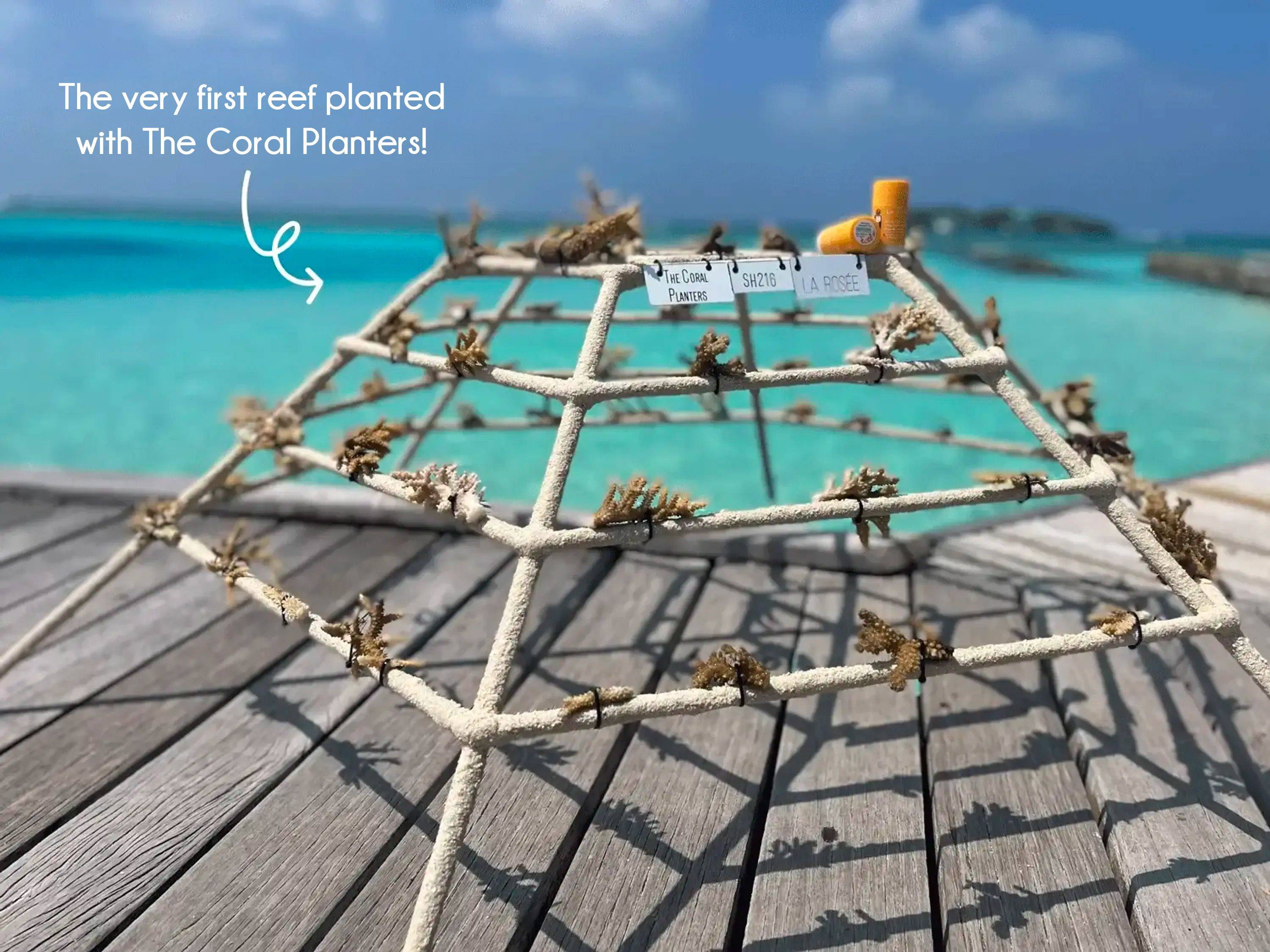
La Rosée is committed alongside The Coral Planters!
To combat the disappearance of coral reefs, we joined forces with The Coral Planters.
In 2022, we helped plant more than 12,000 coral fragments.
La Rosée sun care products protect you effectively.
Click here to learn more!